The Scripture That Speaks Quietly but Runs Deep
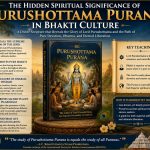
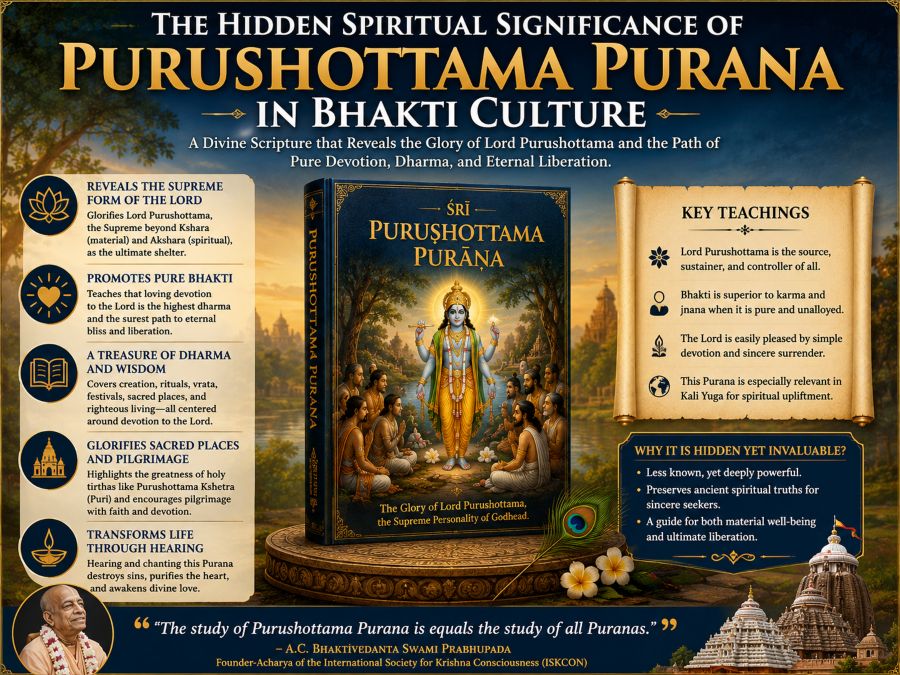
Not every sacred text announces itself with fanfare. Some of the most spiritually potent works in the world’s religious traditions are precisely those that have worked quietly, generation after generation, shaping the inner life of practitioners without ever demanding the spotlight. The Purushottama Purana belongs to this category — a text that, while lesser known in mainstream scholarly conversation compared to the great Mahapuranas, carries within its verses a devotional depth and theological precision that serious practitioners of Bhakti culture have recognized and revered for centuries.
The name itself is a declaration of intent. Purushottama — the Supreme Person, the highest among all beings — is one of the most revered epithets of Lord Vishnu, and specifically of Lord Jagannath of Puri, whose entire theological identity rests on this designation. A scripture bearing this name is not a minor regional text. It is a document that positions itself at the very center of Vaishnava devotional philosophy, claiming that its subject is nothing less than the ultimate nature of the divine and the soul’s proper relationship with that divine reality.
What Is the Purushottama Purana?
The Purushottama Purana is a Sanskrit sacred text closely associated with the Jagannath tradition of Puri, Odisha — one of the four dhamas (sacred abodes) recognized in the pan-Indian pilgrimage tradition. While it is classified among the Upapuranas (secondary Puranas) rather than the eighteen principal Mahapuranas, this classification should not mislead anyone about its spiritual weight. The Upapuranas, taken as a whole, often preserve local and regional theological traditions with an intimacy and specificity that the broader Mahapuranas, in their sweep across all of India, cannot always offer.
The Purushottama Purana is dedicated primarily to the Purushottama Kshetra — the sacred land of Puri — and to the glories of Lord Jagannath, who presides over that kshetra as its eternal sovereign. It describes the origin and significance of the Jagannath temple, the spiritual potency of pilgrimage to Puri, the theology of the wooden form (daru brahma) in which the Lord manifests, and the specific devotional practices — including the great Rath Yatra chariot festival — through which the Lord’s grace flows most abundantly into the world.
But to reduce this text to a pilgrimage manual would be to misread it fundamentally. Embedded within its geographical and liturgical descriptions is a consistent, quietly articulated philosophy of Bhakti that speaks directly to the innermost concerns of every sincere devotee.
Jagannath as Purushottama: The Theology Behind the Name
To understand the spiritual significance of the Purushottama Purana in Bhakti culture, one must first understand what the epithet Purushottama actually means in the context of Vaishnava theology — and why it matters.
In the fifteenth chapter of the Bhagavad Gita, Krishna explains that all of reality is divided into two categories: the perishable (kshara) and the imperishable (akshara). Beyond both stands the Supreme Person — Purushottama — who pervades and sustains the entire creation while remaining entirely transcendent to it. This is not a minor philosophical point. It represents the Gita’s most concentrated statement about the nature of the Absolute: personal, transcendent, and yet intimately present within every atom of existence.
The Purushottama Purana takes this Gita theology and grounds it in the specific, tangible, deeply human reality of Jagannath at Puri. It says, in effect: this is not an abstract philosophical concept. The Purushottama who transcends all categories stands before you in Puri, in a form made of sacred wood, with enormous eyes that see everything, with arms that embrace every soul regardless of caste or qualification. The abstract becomes concrete. The philosophical becomes devotional. The seeker who arrives at Puri as a philosopher departs as a devotee — not because reason has been abandoned, but because it has been fulfilled in something larger than itself.
This theological move — from abstract principle to living, tangible divine presence — is one of the hallmarks of great Bhakti literature, and the Purushottama Purana executes it with particular grace.
The Significance of Daru Brahma: The Divine in Wood
Among the hidden spiritual significances that the Purushottama Purana elaborates, perhaps the most philosophically striking is its treatment of daru brahma — the concept of the Supreme Brahman manifesting as wood.
The image of Jagannath is famously unfinished in appearance — without fully formed hands or feet, with an enormous, all-encompassing gaze, carved from sacred neem wood according to a tradition whose exact origin the text itself explores with devotional reverence. To the casual observer, this form might seem crude, even primitive, compared to the exquisitely detailed iconography of other Vaishnava deities. The Purushottama Purana addresses this perception directly and turns it on its head.
The Lord’s incomplete form, the text suggests, is not a limitation but a revelation. It communicates something about the nature of divine reality that a perfectly completed, conventionally beautiful image cannot: that the divine is not bound by human aesthetic categories, that sacred presence is not contingent on formal perfection, that the Supreme Person can choose any form — including the most unexpected and unconventional — as a vehicle for grace. This is radical theology dressed in wood and color, and the Purushottama Purana is its primary articulation.
For Bhakti practitioners, this teaching has enormous practical implications. It challenges the tendency to condition one’s devotion on favorable outward circumstances — beautiful surroundings, inspiring company, properly conducted rituals. The Lord who chooses an unfinished wooden form to reveal Himself is the same Lord who is present in the imperfect, the ordinary, and the incomplete circumstances of every devotee’s daily life.
The Rath Yatra and Its Hidden Devotional Meaning
The Purushottama Purana is one of the primary scriptural sources for the theology of Rath Yatra — the great chariot festival of Jagannath that has, in modern times, been celebrated not only in Puri but in cities across India and on every continent where Vaishnava communities have established themselves.
On the surface, Rath Yatra is a magnificent public event: enormous wooden chariots, the sound of drums and cymbals, vast crowds pressing forward to glimpse the Lord as He moves through the streets toward the Gundicha temple. But the Purushottama Purana preserves the deeper soteriological meaning of this event — the meaning that transforms it from a cultural spectacle into a genuine vehicle of liberation.
The journey of Jagannath from the main temple to the Gundicha temple is understood, in the text’s theological framework, as the Lord going to the home of His aunt — a journey saturated with the mood of intimate family affection, of the divine voluntarily stepping outside the formality of His own grand residence to move among His people in the open streets. Every person who sees the Lord during this procession — regardless of ritual purity, regardless of caste, regardless of any qualification whatsoever — receives a spiritual benefit equivalent to great austerity and pilgrimage. The Lord brings the temple to the street so that those who cannot access the temple can access Him.
This democratization of divine grace is a defining characteristic of genuine Bhakti theology, and the Purushottama Purana’s treatment of Rath Yatra is one of its clearest and most joyful expressions.
Puri as Moksha-Kshetra: The Geography of Liberation
Another dimension of the text’s spiritual significance in Bhakti culture is its extended treatment of Puri as moksha-kshetra — a place where liberation is available not merely to the spiritually advanced but to any soul that dies within its boundaries.
The Purushottama Purana describes Puri as a place where the Lord Himself acts as the liberating guide for every soul that departs from His kshetra. This is not a minor theological claim. Liberation in most frameworks of Indian philosophy requires decades or lifetimes of sustained practice, purification, and realization. The Purushottama Purana does not deny this general principle, but it asserts that in Purushottama Kshetra, the Lord’s personal grace operates as a direct, unmediated channel of liberation that bypasses ordinary karmic accounting.
For the Bhakti tradition, this teaching carries a profound emotional and theological weight. It affirms that the divine is not a distant, indifferent principle that rewards only the qualified and the pure. It is a living, actively caring presence that reaches toward every soul with generosity exceeding what any soul could claim by its own merit. This is the essential spirit of Bhakti — that love transcends qualification, that grace is genuinely free — and the Purushottama Purana embeds this spirit in the very geography of a sacred land.
Its Living Influence on Odisha’s Bhakti Tradition
The spiritual influence of the Purushottama Purana on the Bhakti culture of Odisha specifically — and on the broader Vaishnava world through Puri’s pan-Indian and now global significance — is difficult to fully measure but impossible to miss.
The great Odia Vaishnava poet-saints, including Sarala Dasa, Jaganath Das, and Balaram Das, all drew from the theological and devotional atmosphere that the Purushottama Purana helped create and sustain. The five panchasakhas (five friends) tradition of Odia Vaishnavism, which represents one of the most distinctive and socially radical expressions of Bhakti thought anywhere in India, is rooted in a Jagannath theology that the Purushottama Purana substantially shaped. Their insistence on the accessibility of the divine to every human being regardless of birth, their celebration of Jagannath as the Lord of the universe who belongs equally to the lowest and the highest — these convictions breathe the same air as the Purana’s own theological vision.
Beyond Odisha, the text’s influence extends through the Gaudiya Vaishnava tradition, which from the time of Sri Chaitanya Mahaprabhu’s celebrated visit to Puri has made Jagannath and the Purushottama Kshetra central to its devotional geography and its understanding of the Lord’s compassionate nature.
Conclusion: A Hidden Treasure Worth Finding
The Purushottama Purana is a hidden treasure of Bhakti culture — hidden not because it has been lost, but because the loudest texts tend to occupy the most space in scholarly and popular attention, while quieter, regionally rooted works do their patient work in the background, sustaining living devotional traditions without requiring recognition.
What this text offers to anyone who approaches it seriously is a theology of divine intimacy: a God who takes an unfinished form so that perfectionism cannot keep you from Him, who comes out of His temple and into the street so that exclusion cannot keep you from Him, who presides over a land where even death becomes a doorway to grace. This is Bhakti at its most essential and most generous — and the Purushottama Purana is one of its clearest, most quietly powerful voices.