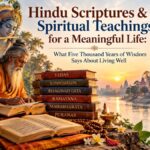
Hindu Scriptures & Spiritual Teachings for a Meaningful Life: What Five Thousand Years of Wisdom Says About Living Well
A man staggers to a lake, desperate with thirst. Just as he bends to drink, a voice from the water stops him: “Answer my questions first.” Four of his brothers ignored that warning. They lie lifeless on the shore. He sits, steadies himself, and the voice asks: What is the most astonishing thing in the world?
His reply, recorded in the Mahabharata’s Yaksha Prashna, still stings: every day people watch others die, yet those left behind live as if they will stay forever. That is Yudhishthira talking. Whether you are reading your first verse or browsing devotional books at Mayapur Store, his answer asks the question this whole article circles: how should a person live, knowing time is short?
The Library That Answers Back
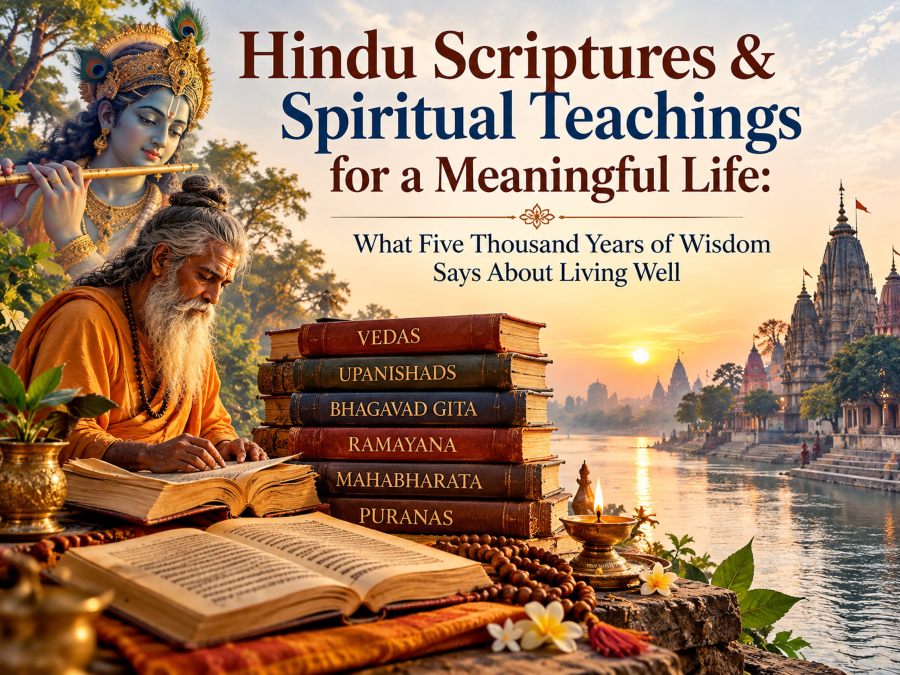
Hindu scripture is not one book. It is a vast, argumentative, deeply practical library, and knowing the shelves saves a lot of confusion.
- The Vedas hold the oldest hymns and rituals, the seed of everything later.
- The Upanishads turn inward and ask who is actually asking the questions.
- The Itihasas (Ramayana and Mahabharata) teach through stories of duty, loss and choices made badly or well.
- The Puranas, including the Srimad Bhagavatam, carry the theology of devotion in narrative form.
- The Bhagavad Gita sits in the middle of the Mahabharata and compresses the whole conversation into 700 verses.
Here is the part most introductions skip. These texts rarely lecture. They stage dilemmas. A warrior freezes on a battlefield. A boy walks into the house of Death and refuses to leave without answers. A king loses everything and must still speak truthfully. You are meant to feel the tension first and take the teaching second. That is why they stick.
Do the Work, Release the Result
Everyone quotes Gita 2.47 and almost everyone softens it. Krishna says you have a right to action alone, never to its fruits. Most people hear “don’t care about results” and reject it, because we plainly do care. That reading is wrong.
Krishna is not asking for indifference. He is pointing at where your attention sits. Picture two people preparing for the same job interview. One rehearses answers and keeps imagining the offer letter. The other rehearses answers and keeps thinking about the next sentence. The second person is calmer, sharper, and, funnily, more likely to be hired. Outcomes depend on a hundred things you do not control. Effort is the only thing that is truly yours.
Three habits make this teaching usable:
- Judge your day by the quality of effort, not by applause or silence.
- Offer the result upward. Many devotees dedicate each task to Krishna before starting. It shifts the question from “will I win?” to “was this offered well?”
- Expect to be disturbed anyway. Gita 2.14 says heat, cold, pleasure and pain come and go, so learn to endure them. Endurance is a skill, not a personality type.
Two Roads at Every Crossroads
The Katha Upanishad gives the sharpest decision framework I know. Death, as teacher, tells the young Nachiketa that life offers two paths: shreya, what is ultimately good, and preya, what is immediately pleasant. Both present themselves to every person. The wise examine them closely and choose the first. The impatient grab the second.
Notice what Death does not say. He does not call pleasure evil. He says pleasure is a poor leader. Scrolling at midnight is preya. Sleeping is shreya. Snapping back at a colleague is preya. Letting a breath pass first is shreya. Neither feels dramatic in the moment, which is exactly why this teaching is hard. A life is the sum of thousands of small crossroads, and most of them look boring.
A simple test: ask, “What will this choice feel like in a year?” If the answer is “nothing at all,” it is probably preya wearing a nice jacket.
Enjoy Things by Letting Go of Them
The first verse of the Isha Upanishad contains a paradox that takes years to unpack: enjoy by renouncing. The text says everything in this world is pervaded by the Divine, so take what is allotted to you and do not covet another’s wealth.
Think about how this plays out. You love a particular chai, a book, a morning walk. The moment you start gripping the thing, afraid to lose it, the pleasure curdles. The moment you hold it lightly, grateful and unclaimed, it gets sweeter. Renunciation in this verse is not about owning less. It is about owning nothing in your heart. A householder with a full kitchen can live it. A monk with a bare cell can fail at it.
Anger Has a Paper Trail
Gita 2.62 and 2.63 trace a chain of events that anyone who has lost their temper will recognise. It begins with dwelling on an object of the senses. From that comes attachment, then desire, then anger. Anger clouds judgment, memory gets scrambled, intelligence fails, and the person falls apart.
What makes this passage brilliant is that it is a diagnosis with a timeline. Most of us try to fight anger at the last step, when it is already shouting. The Gita says to catch it at the first link, the mental replay, the quiet rehearsal of a grievance. By the time you are furious, you have been training for an hour.
Try this the next time irritation surfaces:
- Name the thought that started it. Not the person, the thought.
- Interrupt the replay with chanting, a walk, or a verse you know by heart.
- Return to the situation only when your breath is slow again.
If you want to study these verses with Sanskrit, transliteration and commentary rather than as quotes on a poster, a well-annotated Bhagavad Gita book gives you the full argument surrounding each line. Context changes meaning more often than people admit.
The Mind: Friend or Opponent
Gita 6.5 and 6.6 put the whole inner life in two sentences. Lift yourself by your own mind and do not let it drag you down, because the mind is the friend of the conditioned soul and also its enemy. For one who has conquered it, it is a friend. For one who has not, it behaves like an enemy.
Read that slowly. There is no villain outside you. No fate, no class of people, no stroke of bad luck gets the blame in this verse. It names the one relationship that follows you into every room. A restless mind will turn a good morning into an anxious afternoon. A trained mind can sit quietly in a hospital waiting room.
Training does not mean suppression. The Gita is surprisingly practical here. Verse 6.17 recommends moderation in eating, sleeping, recreation and work. No extremes. No fasting competitions, no all-night heroics. A regular schedule, a clean plate, a clear conscience, and a few minutes of silence do more than any dramatic vow.
Devotion: The Piece Self-Help Usually Leaves Out
Many modern spiritual books borrow mindfulness, discipline and detachment from these texts and quietly drop the heart of them: bhakti, loving devotion.
The Srimad Bhagavatam (1.2.6) says the highest dharma is the kind that leads to unmotivated, uninterrupted devotion to the Supreme, because that alone satisfies the self. Notice the two conditions. Unmotivated means you are not bargaining. Uninterrupted means it is not a weekend hobby. This is a demanding standard, and the tradition knows it. That is why it offers a gentle on-ramp.
In the Gaudiya Vaishnava tradition, that on-ramp is sankirtan, the congregational chanting of the holy names. Sri Chaitanya Mahaprabhu, who appeared in Mayapur, taught that in this age no complicated ritual is required. Chant Hare Krishna, Hare Rama, with attention and humility, and the heart gradually softens. You do not have to understand Sanskrit philosophy to begin. You only have to be willing to listen.
There is a reason devotional practice spreads through homes as well as temples. A tulsi plant on the balcony, a few sticks of incense at dawn, a conch, a small altar: these are not decorations. They are reminders placed where your eyes land, so the mind has something other than a phone to return to.
Humility Is Not Weakness
Chaitanya Mahaprabhu’s Shikshashtaka, verse 3, asks for a temperament that is humbler than a blade of grass and more tolerant than a tree, ready to offer respect to others without expecting it back.
That sounds passive until you try it. Try letting a rude comment go without drafting a clever reply in your head. Try sharing credit at work. Try serving someone who has never thanked you. A tree stands in the sun, gives shade to the one cutting it, and keeps growing. Strength of that kind has no need to announce itself.
Common Mistakes When Reading Scripture
People often stall because of how they approach the text, not because the text is too hard.
- Reading to win arguments. If you only collect verses to defeat someone online, you are using a medicine as a weapon.
- Cherry-picking. A single line pulled from its chapter can say the opposite of what the chapter says.
- Going it alone for too long. Traditions pass wisdom through teachers and communities for a reason. Questions that confuse you for months often dissolve in one conversation.
- Expecting instant transformation. Roots grow before leaves show.
A Daily Rhythm You Can Actually Keep
Nobody needs a two-hour routine to begin. A modest one, repeated, beats a heroic one abandoned on day four.
- Wake up and give the first five minutes to silence. No screen.
- Read one verse. Just one. Write one sentence about what it asks of you today.
- Chant a few rounds of the maha-mantra or any prayer you feel drawn to.
- Do your work as an offering. Remember Gita 2.47 when the day gets noisy.
- Eat with gratitude. Offering food before eating turns an ordinary meal into prasadam.
- End the day with a short review. Where did you choose shreya? Where did preya win? No guilt, only honesty.
Do this for forty days and watch what changes. Not the world, necessarily. The person looking at it.
The Question Still Waiting at the Lake
Back to Yudhishthira. The Yaksha had other questions too, and one more is worth carrying with you. Asked what the path of life is, Yudhishthira said that arguments never settle it, scriptures differ, and no single sage holds all the answers, so the true path is the one followed by great souls.
That is a humble answer from a king who had already lost a kingdom. It is also an invitation. You do not need to resolve every debate about God, time or soul before you begin living better. You need a verse, a habit, a good teacher and honest effort. The texts have waited thousands of years for your attention. They can wait one more morning, but they would clearly prefer you start today.